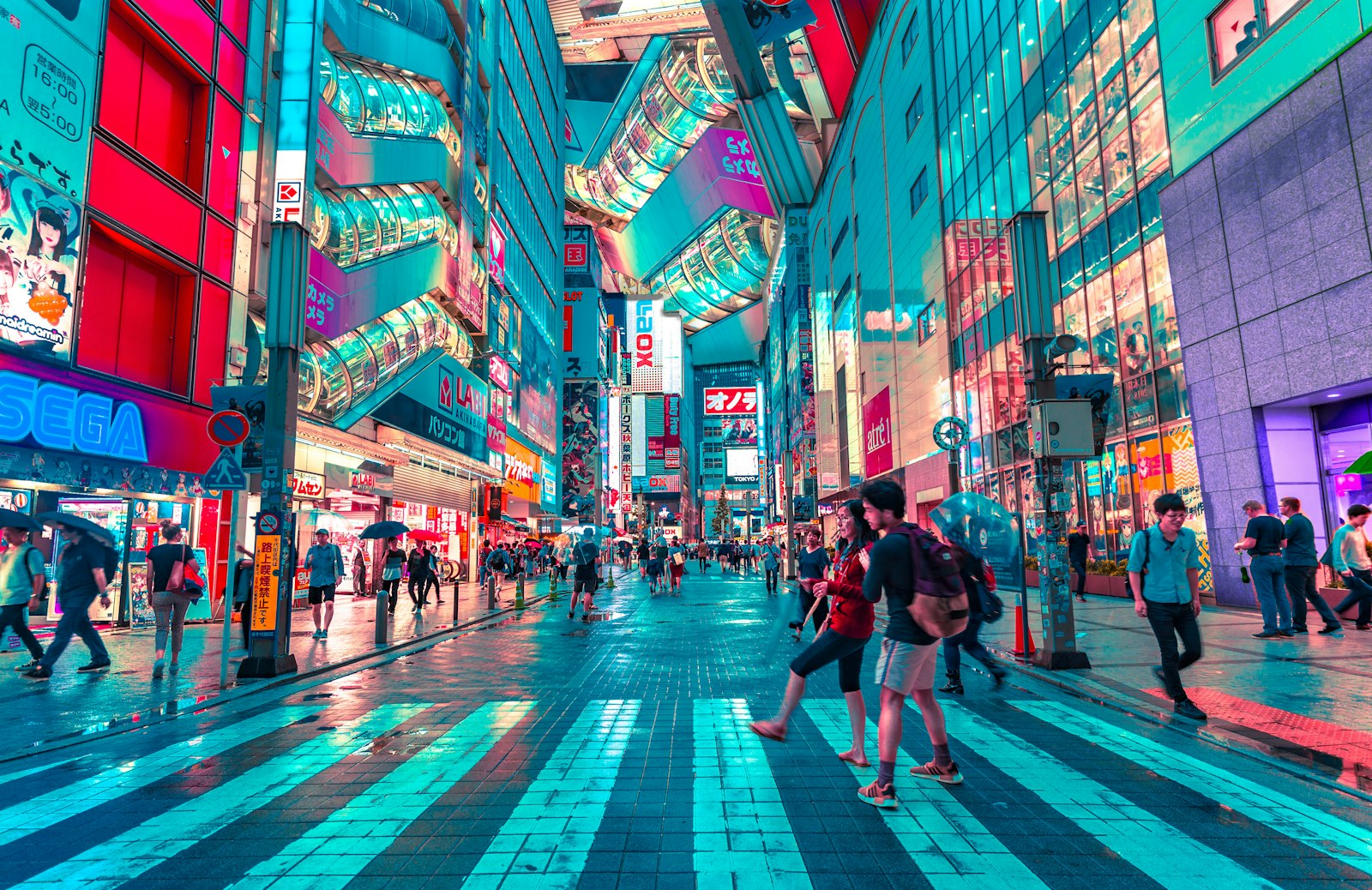
Tokyo's best rooms sit on the fifth floor of an unmarked building. The trains stop around midnight, so plan the way home first.
Live city guides: Tokyo.
Best clubs: Tokyo.
Where to go out
Japan nightlife is organised around the last train. A night starts in an izakaya at about 18:00, moves to a small bar or a karaoke room, and ends either before the trains stop around midnight or after they restart at about 05:00. Convenience stores sell alcohol round the clock, and the drinking age is 20.
Tokyo nightlife is several nights in one city. Shibuya has the big clubs and the crowds of Center Gai, Shinjuku the tiny bars of Golden Gai and the neon of Kabukicho, and Roppongi the foreign-friendly clubs and the loudest touts. Osaka is cheaper and looser, around Dotonbori and Amerikamura. Kyoto is a bar town more than a club town.
The mistake visitors make is the way home. Last trains leave between about 23:30 and 00:30, and a taxi after 22:00 carries a 20 per cent surcharge. Leave by midnight or commit to the first train, and an all-night karaoke pack is the cheap way to wait. Clubs in Tokyo check passports and shoes at the door.
Rooms are private, drinks come by the all-you-can-drink hour and the big chains never close.
Golden Gai in Shinjuku has about 200 bars in six alleys, each seating around eight.
Tokyo has serious rooms such as WOMB in Shibuya, and Osaka has Circus and Joule. Nights end at dawn.
Izakaya counters and small bars are built for one or two people.
Dinner, drinks and a bowl of ramen at 01:00 is the standard shape of a night.
Shinjuku Ni-chome packs small gay bars into a few blocks and hosts Tokyo Pride's Pride Night.
Not for you if you plan to take the train home at 02:00. There is none. Leave by midnight, pay for a taxi, or stay out until the first train at about 05:00.
Three days of outdoor dance music on the Izu peninsula, a half-day trip from Tokyo. In 2026 it ran 17 to 19 April.
Two days in Yoyogi Park, a parade through Shibuya and a Pride Night in Shinjuku Ni-chome. In 2026 it ran 6 and 7 June.
Three days at a ski resort in Niigata, about 90 minutes from Tokyo by Shinkansen plus a shuttle. In 2026: 24 to 26 July.
A month-long festival. Float parades are on 17 and 24 July, with lantern-lit street evenings before each.
Three days in both cities with a different line-up each day. In 2026: 14 to 16 August, at Makuhari in Chiba and Expo '70 Park in Osaka.
Two days of electronic music on the Tokyo waterfront. In 2026: 19 and 20 September.
Friday in Shibuya for a club that runs to the first train, Saturday in Shinjuku for Golden Gai and a late karaoke room.
Two nights in Osaka around Dotonbori and Amerikamura, then half an hour by rapid train to Kyoto for the bars of Kiyamachi and Pontocho.
Two nights in Tokyo, then about two and a half hours by Shinkansen to Osaka for a cheaper, louder weekend.
Three nights in Tokyo, one in Kyoto for a quieter evening, two in Osaka.
Start in Seoul, covered in the South Korea nightlife guide, fly to Tokyo in under three hours and finish in Osaka.
About 200 tiny bars in six alleys. Many are cash only and some charge a cover, so read the sign on the door.
Small dishes, draught beer and a seat charge. The standard start to a night.
A private room and a night pack from about midnight to 05:00, usually ¥2,000 to ¥3,500 per person. It doubles as somewhere to wait for the first train.
Rooms such as WOMB in Shibuya run until morning. Ride the first train home at about 05:00 with everyone else.
A few blocks of small LGBTQ+ bars with regular crowds and cover charges.
Canal-side street food and neon, then the clubs a few minutes away.
Noodles in pork or soy broth, eaten to finish a night, a habit called shime. Shops near Shinjuku and Shibuya stations stay open into the early hours. About ¥900 to ¥1,300.
Sliced beef over rice. Yoshinoya, Sukiya and Matsuya have many branches open 24 hours, about ¥450 to ¥600 a bowl.
Rice balls from a konbini, the convenience stores that never close. About ¥150 to ¥250 each.
A savoury cabbage pancake cooked on a hot plate, the Osaka classic. Served around Dotonbori and Namba into the late evening.
Fried batter balls with octopus inside, sold from stands in Dotonbori and Namba.
Normal club nights admit guests aged 20 and over, and staff want the physical passport or residence card. Sandals, cargo shorts and sportswear are the usual reasons for refusal.
Entry of ¥1,500 to ¥4,000 usually includes one or two tickets to swap at the bar. Some clubs price by gender, and a few by nationality.
Tipping is not expected. Many bars add an otoshi, a seat charge of about ¥300 to ¥700. Small bars, including many in Golden Gai, take cash only, and Seven-Eleven cash machines accept foreign cards.
In Roppongi, Kabukicho, Shinsaibashi and Dotonbori, touts steer foreigners into bars with hidden charges and strong drinks. Some victims have been walked to cash machines.
Cannabis use became a crime in December 2024, with up to seven years in prison. MDMA and cocaine carry up to seven years. Police can detain you for up to 23 days, and trace amounts can be enough.
Some clubs put a sticker over your camera. Leave it on.
| Club entry | ¥1,500–4,000 (€8.50–23), usually with a drink ticket |
| Beer in a bar | ¥600–900 (€3.40–5.10) |
| Beer from a convenience store | about ¥250–300 (€1.40–1.70) |
| Cocktail | about ¥900–1,300 (€5–7.30) |
| Tokyo Metro ticket | ¥180–330 (€1–1.90) |
| Taxi, Shibuya to Shinjuku after 22:00 | ¥2,000–3,000 (€11–17) |
| Bowl of ramen | about ¥900–1,300 (€5–7.30) |
| Karaoke night pack | about ¥2,000–3,500 (€11–20) |
Convenience-store cans, one small bar, ramen and a karaoke night pack instead of a taxi.
An izakaya dinner, a club door with a drink ticket, one more drink, ramen and trains.
A Roppongi or Shibuya club, several cocktails, a late dinner and a taxi across town.
Trains and metro stop between about 23:30 and 00:30 and restart around 05:00. After that: taxis, a few Toei night buses until about 04:00, a karaoke room, or a manga cafe at about ¥1,000 to ¥1,500 for three hours. Taxis add 20 per cent from 22:00 to 05:00. Book with GO, S.RIDE, Uber or DiDi.
The Japan drinking age is 20, though adulthood starts at 18. Clubs want a passport or residence card, and tourists must carry a passport anyway.
Bring cash. Small bars are often cash only, and Suica and PASMO transit cards also pay in convenience stores.
Many club nights sell at the door; bigger ones are on Resident Advisor. Festivals sell online well ahead.
Public drinking is generally tolerated, with exceptions. Shibuya bans it around the station, Center Gai and Miyashita Park from 18:00 to 05:00 all year, and Kabukicho has a similar ban. Extra rules apply at Halloween.
The main risk is the bar scam: touts, strong or spiked drinks and forced cash withdrawals in Roppongi, Kabukicho, Shinsaibashi and Dotonbori. Agree prices before you order.
Bars with paid staff must confine smoking to smoking rooms. Small owner-run bars with no paid staff that opened before April 2020 can still allow it, so some tiny bars are smoky.
English is limited in small bars. Learn kanpai for cheers and okaikei onegaishimasu for the bill.
Yes. Tokyo and Osaka offer izakaya, tiny bars, karaoke and clubs open until the first train. The catch is that trains stop around midnight.
Most clubs in Tokyo and Osaka run until about 05:00 so guests can take the first train. Karaoke chains stay open all night.
About €30 (¥5,000) for a cheap night, €50 (¥9,000) for a normal one with a club door, and €100 (¥18,000) or more for a big night.
20. Clubs check passports, even though the age of majority is 18.
Tokyo for range and clubs. Osaka is cheaper and looser, and Kyoto suits a quieter night in bars.
Take a taxi, about ¥2,000 to ¥3,000 between Shibuya and Shinjuku, or wait in a karaoke room or manga cafe until the first train at about 05:00.